Barcode Identification
Complete guide to identifying barcode types — linear (1D), two-dimensional (2D) and postal. Useful for choosing the right scanner, printer or software.
How to identify a barcode
If you have a barcode and don't know what type it is, follow these steps:
-
1
Check if it's made of a series of vertical bars (1D linear/postal) or a matrix of squares/dots (2D).
-
2
If linear, read the text below — EAN/UPC/GS1 formats have longer edge and center bars.
-
3
If 2D with 3 large squares in corners, it's a QR Code. If it has a smaller square pattern, it's Data Matrix.
-
4
Compare the first and last bar structure with the reference tables below (W = wide bar, N = narrow bar).
Note: More details and a complete symbology database available at barcode.ro.
1D Linear Barcodes
Linear barcodes consist of a series of bars — some thinner, others thicker — and spaces between them. They are the most widespread types of barcodes.
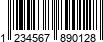
EAN-13
barcode.ro ↗Standard European barcode for commercial products. Encodes 12 digits plus an automatically calculated check digit. Romanian products use prefix 594 (GS1 Romania) or 642 (ARPC).

EAN-8
barcode.ro ↗Compact version of EAN-13 for small products where space is limited. Encodes 7 digits plus a check digit.
UPC-A
barcode.ro ↗American retail product standard. Encodes 11 digits plus a check digit. Widely used in the USA and Canada.

UPC-E
barcode.ro ↗Compressed version of UPC-A for small products. Encodes 5 digits plus a check digit through zero suppression.
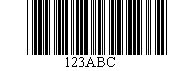
Code 39
barcode.ro ↗The most widely used format outside retail. Encodes digits and uppercase letters (A-Z, 0-9) plus special characters. Self-checking, no mandatory check digit.
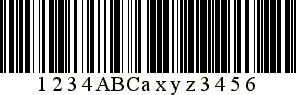
Code 128
barcode.ro ↗High-density format supporting the full ASCII character set (128 characters). Variants A, B and C allow optimal encoding for various data types.

Code 93
barcode.ro ↗Compact variant of Code 39. Offers higher density, occupying less space for the same data. Includes two check digits.

Interleaved 2 of 5
barcode.ro ↗High-density numeric format. Encodes pairs of digits — one in bars, one in spaces — resulting in twice the density of Standard 2 of 5.
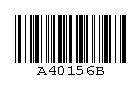
Codabar
barcode.ro ↗Used in libraries, blood banks and courier services. Uses start/stop characters (A, B, C, D) and does not require a check digit.
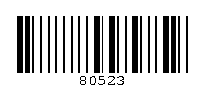
MSI (Modified Plessey)
barcode.ro ↗Fixed-length format used mainly for shelf labeling in retail. Requires manual addition of the check digit.
2D Barcodes — Two-dimensional
Two-dimensional codes consist of a series of rows one above another, or from a matrix of squares, diamonds, circles or dots. They store far more information than linear barcodes.
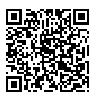
QR Code
barcode.ro ↗The most popular 2D code. Matrix symbology with 3 positioning squares in corners. Supports 4 error correction levels. Can encode up to 2,509 digits or 1,520 alphanumeric characters. Readable regardless of orientation.

Data Matrix
barcode.ro ↗Composed of squares arranged in a pattern. Widely used for serializing electronic products and in manufacturing. The symbol can appear as a square or rectangle. Supports advanced error correction.

PDF-417
barcode.ro ↗Capable of encoding 1 KB of information. Automatic error correction that allows recovery of damaged codes. Available in over 900 different encoding models. Used on identity documents and tickets.

Aztec
barcode.ro ↗Supports the full ASCII character set with multiple error checking modes. Symbols remain readable regardless of orientation. Used for transport tickets and travel documents.
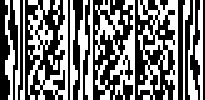
Micro PDF-417
barcode.ro ↗Multi-row format based on PDF-417, designed for applications requiring high efficiency with reduced storage capacity. Ideal for small labels.

Codablock F
barcode.ro ↗2D symbology based on Code 128 format, capable of encoding the complete ASCII character set. Composed of multiple rows of Code 128 codes.

GS1 DataBar
barcode.ro ↗Family of symbologies combining linear and 2D formats. Also known as EAN.UCC or Reduced Space Symbology (RSS). Used for small products in retail.

Code 16K
barcode.ro ↗Allows character encoding using a modified Code 128 version. Each row begins and ends with control characters indicating the row number and reading direction.
Postal Barcodes
Postal barcodes are used by courier and postal services around the world for automatic sorting and delivery of correspondence. They consist of bars with approximately the same spacing between them, with varying heights.

Postnet
barcode.ro ↗Barcodes used by the US postal service. Three variants: Postnet A (5 characters — zip code), Postnet C (9 characters — Zip+4) and Postnet C' (11 characters — delivery point).
FIM (Facing Identification Mark)
barcode.ro ↗Used to increase correspondence processing speed in the USA. Four types (A, B, C, D) for different mail categories.

Planet
barcode.ro ↗Similar to Postnet, formed from 9 digits and contains a check character. Used for mail delivery confirmation.
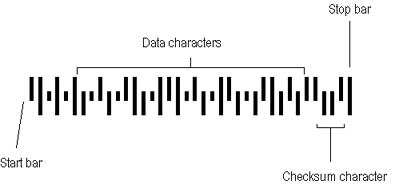
RM4SCC (Royal Mail)
barcode.ro ↗Barcode format used by the UK postal service. Contains start, stop and control characters. Encodes UK postcodes.
4-State Customer Code
Similar to RM4SCC format and is used in certain European countries for automatic mail sorting.

Australian Post
barcode.ro ↗Uses Reed-Solomon error correction. Four variants available for different types of Australian mail.
Intelligent Mail (IMb)
barcode.ro ↗The modern replacement for Postnet in the American postal system. Combines information from Postnet and PLANET into a single compact barcode.
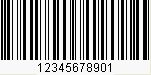
Deutsche Post
barcode.ro ↗Barcode format used by the German postal service for automatic sorting and tracking of correspondence.
Barcode Generation
For free online barcode generation, access the dedicated Rosistem platform. Supports all major formats — EAN, UPC, Code 128, QR Code, Data Matrix and many more.
- Free online generation — no registration
- All 1D, 2D and postal formats
- Export PNG, SVG, EPS, PDF
- Bulk generation with CSV import
Other Rosistem solutions
Barcodes are the foundation of all our solutions. Explore the complete platform.
Need barcode scanners or printers?
Rosistem offers hardware and software for all types of barcodes. Contact us for a free consultation.